In our previous article, we noted that achieving national unity is one of the greatest challenges facing states in general. Unless the political body, so to speak, achieves an appropriate degree of unity around the state’s broad visions and objectives, the state will remain incapable of fulfilling its goals and functions and will continue to suffer from instability and uncertainty.
We also concluded that national unity in Sudan faces a number of challenges, including the relative modernity of the Sudanese state itself, the dominance of sub-national loyalties at the expense of loyalty to the nation, the absence of balanced development, the lack of a clear vision for managing ethnic diversity, the tendency of different Sudanese regions to follow the example of the South in seeking separation, and foreign interference in Sudanese affairs.
In this part of the article, we will attempt to outline the broad features of a strategic perspective for consolidating national unity in Sudan. We believe that such a perspective should be based on the following:
1. Explicit and Clear Recognition of Sudan’s Ethnic and Cultural Diversity
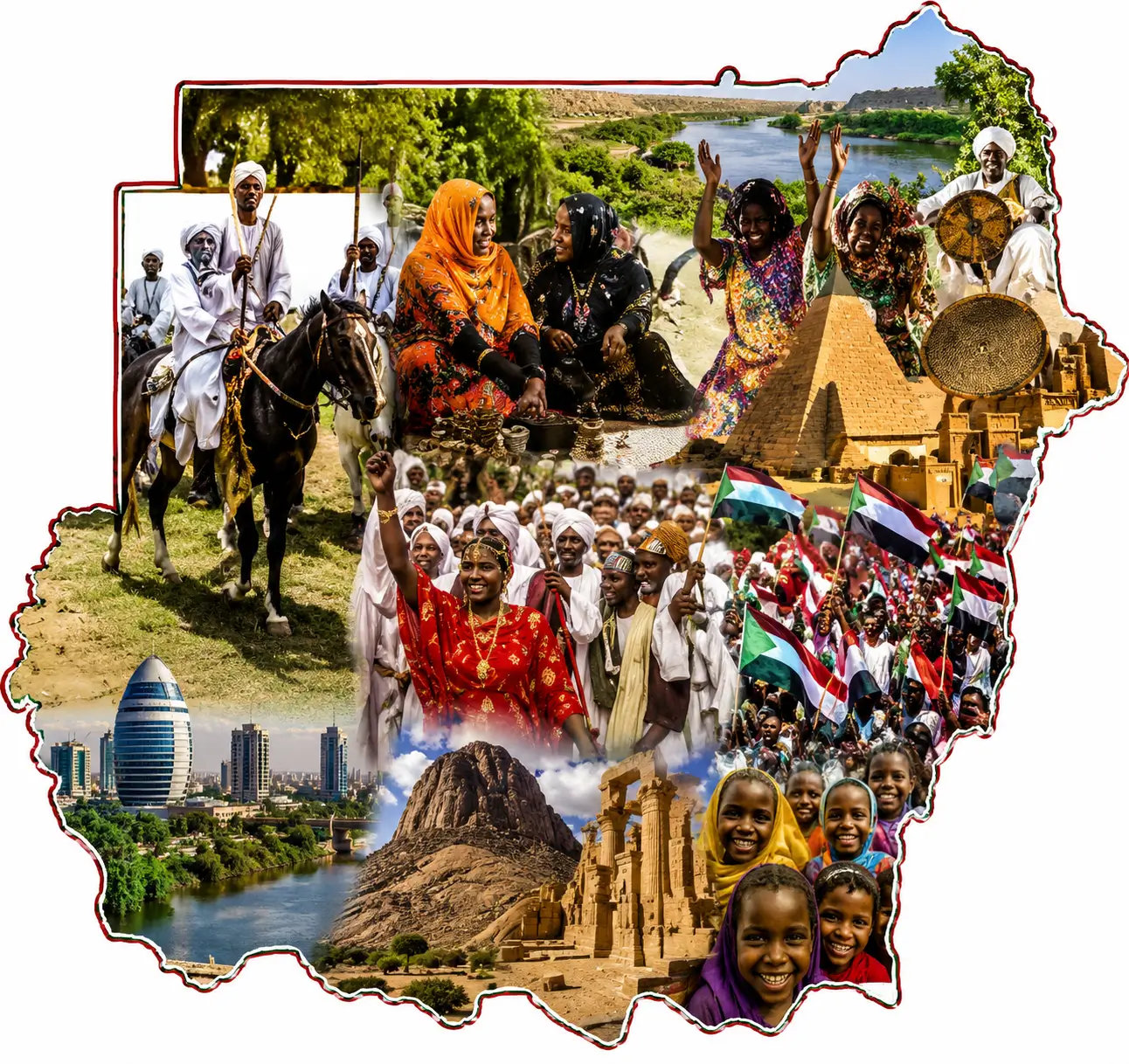
Sudan is often described as a “miniature Africa” because of its extensive ethnic and cultural diversity. Even after the secession of South Sudan, present-day Sudan still contains hundreds of sub-groups, dozens of languages and dialects, as well as religious diversity.
As scholars and thinkers have pointed out, diversity in itself is not necessarily a source of weakness. On the contrary, it can become a source of enrichment, resilience, and strength. Therefore, the first pillar of this strategic perspective should be full recognition of Sudan’s ethnic and cultural diversity and a serious effort to transform that diversity into a source of strength and cultural enrichment rather than fragmentation, division, and weakness.
Turning diversity into a source of strength, however, requires a range of policies and measures, many of which will be discussed in the points that follow.
2. Enabling Different Sudanese Groups to Express Their Interests and Cultural Distinctiveness
Pluralism cannot become a source of strength and enrichment unless different groups are enabled to participate in governance on an equal footing with others and are given the freedom to express their cultural identities and distinctive characteristics.
3. Striving to Achieve Balanced Development Throughout the Country
This requires reconsidering the development plans and strategies implemented in Sudan from independence to the present, and making a serious and sustained effort to achieve comprehensive, sustainable, and balanced development.
The objective should be to improve the living conditions of all citizens, eliminate economic grievances, and address the discourse of “marginalization” that has become increasingly prominent in recent years.
This requires the participation of Sudanese economic experts in developing the country’s plans and development strategies, while giving special priority to less developed regions in order to reduce the gap between the center and the peripheries.
It also requires continuous review of development plans and strategies and directing national resources toward development and reconstruction.
4. Expanding Public Freedoms
The expansion of public freedoms is the backbone of national unity. These freedoms should include freedom of expression, freedom of association, and freedom of religious belief.
Discussion of justice, equality, and the rule of law becomes meaningless unless all Sudanese citizens are able to express themselves freely, regardless of their ethnicity, language, or religion.
When a Sudanese citizen feels able to express opinions freely and without fear, this strengthens loyalty to the state and reinforces the sense of being an integral part of the national community. By contrast, a political system based on suppressing freedoms unnecessarily alienates citizens from the state.
Expanding freedoms also creates opportunities for objective dialogue on national issues, helps correct mistakes, closes institutional gaps, brings differing viewpoints closer together, and removes artificial barriers between rulers and the governed.
5. Establishing New Foundations for the Distribution of Economic Resources and Political Opportunities, Away from Tribal and Regional Balancing
Many groups in different parts of Sudan have resorted to what may be described as politicized ethnicity in pursuit of their interests. Some took up arms against the central government, mobilized local populations, attempted to turn them against the government, and revived sub-national loyalties, all under the banner of “marginalization.”
While the central government may previously have adopted tribal and regional formulas for distributing political opportunities and economic gains in agreements with armed movements, there is now a need—particularly after the National Dialogue—to move away from such an approach, as it represents one of the greatest threats to national unity.
Unless new principles are established, guided by the outcomes of the National Dialogue, for distributing economic resources and political gains, national unity will remain at risk.
The most effective and direct way to address grievances and marginalization is to uphold justice and transparency. Establishing clear and transparent standards for power-sharing and wealth distribution would help achieve justice, reduce the likelihood of conflict, and strengthen the government’s own position.
Clearly, it is not in the interest of any government to preside over severe developmental disparities or widespread grievances within the country it governs.
6. Reaching Agreement on the Foundations of Sudan’s Political System
Building on the above, and in order to strengthen national unity and enable different Sudanese communities to live together in peace and dignity, the foundations of the political system must be clearly defined.
When we speak of “agreement on the foundations of the political system,” we mean reaching consensus on a Sudanese constitution accepted by the country’s various political forces without exclusion or restriction, because the constitution is a public matter concerning all Sudanese people, both rulers and citizens.
It should also be noted that Sudan has a rich history of drafting—and abolishing—constitutions. Numerous attempts have been made to establish a permanent constitution for the country, beginning with the Ziyada Arbab Committee around the time of independence, followed by attempts during the second democratic period in the 1960s, Jaafar Nimeiri’s 1973 Constitution, efforts during the third democratic period, the 1998 Constitution, and finally the 2005 Constitution.
This is in addition to other attempts that did not produce tangible results. All of these experiences should be studied, built upon, and used as lessons for the future.
For example, we believe that some of the principles contained in the Comprehensive Peace Agreement signed in Naivasha and later incorporated into the 2005 Interim Constitution provide a sound and fair foundation for governance in Sudan.
The secession of South Sudan does not necessarily mean that these principles should be abandoned, especially because Sudan continues to display many of the same characteristics that existed before secession, most notably ethnic, religious, and linguistic diversity, as well as developmental disparities.
The first section of the agreement, dealing with general principles, stated the following:
- The unity of Sudan, founded on the free will of its people, democratic governance, equality, mutual respect, and justice for all Sudanese citizens, shall remain the highest priority.
- Establishing a democratic system of governance that takes into account the ethnic, cultural, religious, and linguistic diversity of the Sudanese people, as well as gender equality.
- Developing a comprehensive solution that addresses Sudan’s economic and social decline and achieves social, political, and economic justice for all Sudanese citizens.
The 2005 Interim Constitution reflected these principles in Chapter One (Article 4 – General Principles of the Constitution) as follows:
This Constitution shall be founded on and guided by the following principles:
(a) The unity of Sudan shall be based on the free will of its people, the supremacy of the rule of law, decentralized democratic governance, accountability, equality, respect, and justice.
(b) Religions, beliefs, traditions, and customs are sources of moral strength and inspiration for the Sudanese people.
(c) The cultural and social diversity of the Sudanese people is the foundation of national cohesion and shall not be exploited to create division.
(d) The authority and powers of government derive from the sovereignty and will of the people, exercised through referenda and free, direct, and periodic elections conducted by universal secret ballot for those who have reached the age prescribed by law.
The Constitution also emphasized the need to establish a model of good governance in Sudan based on equality, respect for human rights, transparency, accountability, and the rule of law. It went even further by stating that “all rights and freedoms enshrined in international human rights agreements, covenants, and conventions ratified by the Republic of Sudan shall form an integral part of this document.” These are all positive provisions, although some may require review to ensure consistency with Islamic principles in these areas.
The Constitution also stressed the need for national standards that reflect the unity of the country and the diversity of the Sudanese people. It affirmed the importance of promoting the welfare of the population and protecting their human rights and fundamental freedoms.
It further detailed the rights and freedoms to be enjoyed under the Sudanese Constitution, including the right to life, personal liberty, protection from slavery and torture, the right to a fair trial, respect for privacy, freedom of thought, conscience, and religion, freedom of expression, freedom of assembly and association, the right to establish a family and marry, the right to vote, equality before the law, protection from discrimination, freedom of movement, children’s rights, and others.
I believe that these principles enjoy broad consensus among the Sudanese people as a whole, since it is difficult to imagine anyone openly advocating the opposite. Where particular provisions require regulation or review, they can be discussed and reconsidered through dialogue.
7. Excluding the Right to Self-Determination from Future Negotiations Between the Government and Armed Movements
Recognizing what is termed the “right to self-determination” for any part of Sudan would, in practice, almost inevitably lead to the secession of that region. International and regional experiences have shown that once such a right is granted, the likely outcome is separation. This occurred in the former Yugoslavia, the former Soviet republics, and neighboring Eritrea, despite the differences in circumstances and contexts. After the secession of South Sudan, voices also emerged calling for the right to self-determination for other parts of Sudan.
The United Nations recognized the complexity of this issue at an early stage. In 1947, two years after the establishment of the United Nations, the General Assembly discussed the meaning, scope, and limits of the principle of self-determination contained in the UN Charter. Its position in this regard emphasized that the right to self-determination should not be confused with minority rights. Extending self-determination indiscriminately to minorities, it was argued, could generate instability in the international system, particularly because very few states are completely homogeneous in ethnic, cultural, or social terms.
The General Assembly also noted that broadening the principle to apply to minorities could place existing political affiliations and national borders under constant challenge.
It is true that approaching the Sudanese situation in terms of majority and minority categories is not entirely accurate, because Sudan contains numerous ethnic and cultural groups, and even a numerically large group may constitute a minority in relation to the combined presence of others. Nevertheless, the underlying concern remains valid: the indiscriminate application of self-determination could generate instability in the international system.
Given that one of the United Nations’ principal objectives is the maintenance of international peace and security, it would be inconsistent for it to promote an approach that could contribute to widespread fragmentation and instability.
Although self-determination has been granted to certain groups as part of political settlements in some countries, the international community has generally not sought to establish this as a universal entitlement applicable in all cases.
Rather, even when international actors have helped facilitate referenda in particular territories, the broader tendency has been to improve the conditions of minorities and marginalized groups within their existing states by pressing governments to expand their participation in political power and national wealth, rather than encouraging them to separate and establish independent political entities. Exceptions have, of course, occurred where major powers believed separation served their interests.
At the regional level, African leaders addressed the issue of arbitrary and artificial colonial borders at the 1963 Conference of Independent African Heads of State in Addis Ababa. They acknowledged that these borders often failed to reflect demographic realities, sometimes dividing the same ethnic community between several political entities and incorporating within one state hundreds of ethnic groups with few historical ties to one another.
Nevertheless, they affirmed the principle of the inviolability of inherited colonial borders in order to prevent conflicts among African states. These borders were therefore preserved despite their arbitrary origins.
This principle was subsequently reaffirmed within the framework of the African Union. As a result, changing existing borders to address ethnic, cultural, or developmental differences is no longer regarded as a generally acceptable approach.
Accordingly, the broad application of self-determination in this manner conflicts with established regional and international principles and could have serious consequences for the future of many states.
The granting of self-determination to southern Sudan was based on a political agreement between the government and the Sudan People’s Liberation Movement as part of a settlement to a conflict widely described as one of the longest-running wars in Africa.
Sudan therefore needs a clearly defined understanding of the meaning, scope, and limits of self-determination, given its direct connection to the future unity and cohesion of the country.
8. Developing and Strengthening Sudan’s Foreign Relations
The central role played by neighboring countries in Sudanese conflicts, both positively and negatively, has become increasingly clear.
Because of the extensive demographic and ethnic overlap between Sudan and its neighbors, it is difficult to speak realistically of completely neutralizing neighboring states in Sudanese conflicts.
At the same time, in the era of globalization, domestic affairs are no longer matters that concern the state alone. Other countries—particularly Western European states and the United States—have become deeply involved in such conflicts, whether in war or peace. Regional and international organizations have also become increasingly present.
This makes foreign policy an essential consideration when addressing what may initially appear to be “internal” conflicts.
The Sudanese state must therefore strengthen its relations with neighboring countries and seek to channel their influence in ways that serve Sudan’s national interests. At the same time, it should work energetically to rebuild and strengthen its relations with major powers and with international and regional organizations.
In the era of globalization, internal affairs can no longer be treated as exclusively domestic matters. Foreign states, especially in Western Europe and North America, frequently engage with such conflicts, whether through mediation, political pressure, humanitarian involvement, or other forms of intervention. Regional and international organizations also play increasingly prominent roles.
It is therefore essential to incorporate the external dimension into any serious analysis of Sudan’s internal conflicts.
In conclusion, we believe that the following measures could contribute to strengthening and consolidating national unity in Sudan:
Full and explicit recognition of Sudan’s ethnic and cultural diversity.
Enabling different Sudanese groups to participate equally in power and wealth and to express their cultural identities on an equal footing with other citizens.
Pursuing balanced development throughout the country and placing this objective at the heart of national development plans.
Expanding public freedoms and establishing democratic governance based on transparency, accountability, and the rule of law.
Establishing new principles for the distribution of economic resources and political opportunities, free from tribal and regional considerations.
Reaching consensus on the foundations of Sudan’s political system and adopting a Sudanese constitution that reflects the realities of the country while taking into account national, regional, and international political developments.
Excluding the so-called right to self-determination from future negotiations between the Sudanese government and any armed movement or political group in order to preserve the territorial unity of Sudan.
Giving greater attention to Sudan’s foreign relations, with particular priority to neighboring African states, while also strengthening relations with the Arab world, Western European countries, the United States, and international and regional organizations.
0 Comments