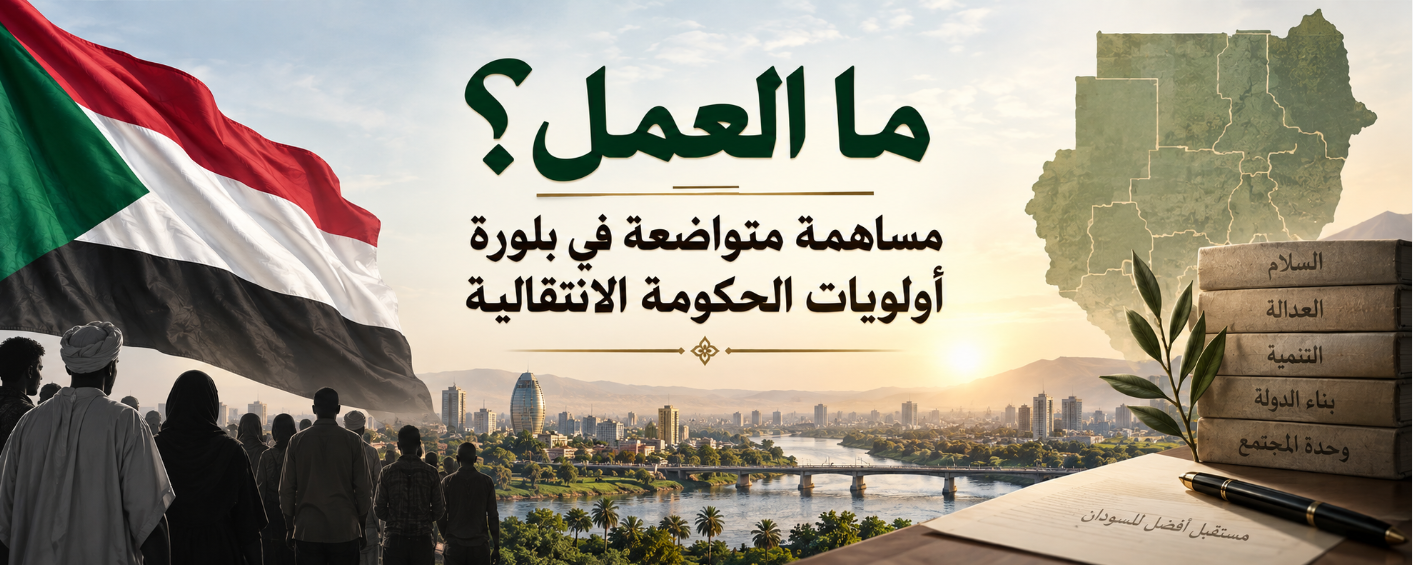
The Ingaz (Salvation) government has fallen and its era has come to an end, marking the beginning of a new phase in Sudan’s history. Following the fall of Bashir’s government and the formation of the institutions of the transitional period, a number of important and legitimate questions have emerged: What does the new government intend to do? Will Sudan witness genuine transformations affecting its economic, social, political, cultural, educational, artistic, sporting, and other spheres of life? What is the transitional government’s program? What are its priorities? Where will it begin, and where will it end? What opportunities are available to it, and what challenges does it face? How will it deal with Sudan’s urgent realities, complex crises, and deeply intertwined and long-standing problems?
These questions are undoubtedly a fundamental right of the Sudanese citizen. Citizens have the right to know where the country is heading and what plans and policies their government intends to pursue, because they are the beneficiaries if the government succeeds and the ones who bear the consequences if it fails.
Conscious and engaged societies that care deeply about national issues—such as the great Sudanese people—do not wait to be invited before expressing their views about their future and destiny. Rather, they take the initiative to voice their opinions on every major national issue, sparing no effort in doing so.
Good and responsible governments are those that encourage popular participation, take public opinion seriously, and open their doors to citizens’ views, demands, and complaints. They provide people with opportunities to express themselves freely on national issues and seek to understand their attitudes and opinions concerning policies and measures already adopted or still under consideration. Such governments should be prepared to decide, correct, review, and even reverse course in response to public feedback.
On the basis of this introduction, this article represents a modest attempt to offer some answers to the major questions raised by the fall of the Ingaz regime. The fall of a political system, whether in whole or in part, does not necessarily mean that the country’s underlying problems have been solved.
Perhaps this misconception lies at the heart of many of our difficulties. Indeed, it has been a recurring problem across much of the developing world. After many countries succeeded in defeating colonial rule, they assumed that the road ahead would be smooth and that their economic and social problems had already been resolved. They expected that within only a few months they would achieve prosperity, growth, and development comparable to that of the countries that had once colonized them.
This expectation was not confined to ordinary citizens. It was also widespread among national elites, perhaps almost without exception. As a result, many of these elites failed to study their societies carefully or prepare adequately for the post-independence period. They neither made sufficient preparations nor equipped themselves for the challenges ahead. The result was profound failure, continued decline, and repeated disappointment.
The starting point for reform, therefore, is to determine where we are now, where we want to be, and how we can reach the future we seek.
This is the approach that will be followed in this article, beginning with the crucial question:
Where are we now?
The answer to this question is the essential starting point for addressing all the other questions.
“Roots of Dysfunction” and Manifestations of the Imbalance:
Sudan emerged from the era of the Ingaz (Salvation) regime weakened and exhausted as a result of misguided policies and corrupt practices. Although we had long described ourselves as the “food basket of the Arab world,” we became unable even to produce enough food for ourselves. We were reduced to seeking food assistance from countries whose people our own ancestors had once helped sustain.
Women, men, and children stood in bread lines, and this humiliating reality was witnessed near and far. Sudan became known around the world as an example of hunger, poverty, and deprivation. We became an object of pity and sympathy for some, and of ridicule and contempt for others.
Our factories and institutions ceased functioning and were reduced to ruins that break the heart, reminders of a proud past, a vanished glory, and of “a people’s structure brought down.”
The Bashir government failed to confront the country’s economic, social, political, and security challenges, and these problems worsened under its rule. But how could it have been capable of addressing such challenges after driving away Sudanese professionals and experts in every field: experienced economists, qualified doctors, distinguished engineers, veteran university professors, accomplished legal experts, talented intellectuals, and many others?
These Sudanese professionals are now, regrettably, helping to build other countries through their contributions to education, infrastructure, healthcare, and other sectors. They have become examples of competence, professionalism, dedication, high moral standards, and adherence to noble religious values.
They left because they could no longer secure even the most basic requirements of a decent life in their own country. They departed reluctantly and under pressure, their hearts aching at the thought of leaving their homeland and families behind.
Our education system, which had once been a source of pride not only regionally but internationally, deteriorated severely during the Ingaz era. Countries that had once relied on Sudanese expertise to establish their schools and educational institutions and to develop their curricula came to look upon us with contempt.
Our universities, which had once competed with respected institutions around the world, disappeared almost entirely from major international and regional university rankings.
The forced removal of qualified professionals, combined with what the government called “dismissal for the public interest,” through which some of the most distinguished leaders of the civil service were removed, created opportunities for individuals lacking scientific qualifications and institutional, professional, and ethical standards to occupy senior positions in public institutions.
They proceeded to damage these institutions, whether deliberately or through incompetence, and the result was comprehensive destruction affecting almost every aspect of life. As the old poet said:
Affairs are properly managed by people of wisdom so long as they remain upright;
but when they withdraw, affairs fall into the hands of the wicked.
The verses of the poet Ali Nour, written in a period better than the Ingaz era, became even more applicable:
Everyone in Sudan occupies a place that is not his own;
wealth is in the hands of the miser, and the sword in the hands of the coward.
A man is no longer judged by his two finest qualities—his heart and his tongue—
but by the perfection of his appearance, pretension, and flattery.
During the Ingaz era, this proud and politically conscious people came under the rule of leaders afflicted with what might be described as aphantasia—an inability to imagine. They stumbled from one policy and decision to another until they brought us to a point where we found ourselves wishing we could return to the 1960s.
During the years of Ingaz, the Sudanese political arena was almost entirely devoid of genuine creativity in developing unconventional solutions to the problems of administration, economics, politics, and society.
Government “thinkers” continued repeating familiar and worn-out formulas that had been circulating for decades, despite the profound changes taking place within the country and the rapid global transformations that required adaptation and responsiveness if Sudan was not to fall even further behind other nations.
The list could go on at length, covering the major failures and obvious manifestations of dysfunction that characterized Sudanese politics during the Ingaz era, particularly in its final years.
Where Should We Begin the Reform Process
Now that the Sudanese people have freed themselves from all that mismanagement, the time has come to move toward the future with clarity and foresight, led by qualified and capable citizens toward a more promising national future.
This does not mean, of course, that the road ahead for the new government will be easy or free of obstacles. In reality, it faces a number of fundamental challenges that must be addressed with determination and resolve. These include strengthening national unity, tackling persistent economic problems, confronting political, administrative, and financial corruption, addressing serious social problems within Sudanese society, reforming the education system, and rebuilding Sudan’s foreign relations. These are only examples of the major challenges the government must confront.
For the government to succeed, it must begin with a clear understanding of these deep-rooted, complex, and long-standing challenges and address them through a carefully designed and scientific approach, far removed from randomness and improvisation.
The country is facing complex and decisive issues at a critical historical moment that leaves no room for confusion or experimentation. The choice is therefore clear: either adopt systematic and scientifically grounded planning capable of addressing weaknesses across different sectors and opening the way toward progress and national renewal, or continue with improvised policies that could lead the country toward disastrous consequences.
What, then, does the Sudanese people expect from this government?
It is, of course, impossible to cover all the problems facing Sudan or all the issues that the new government must address. Nor is it possible here to discuss each issue in full detail. It is sufficient, for now, to draw attention to the most important ones in the hope that further opportunities may arise—whether for us or for others—to examine them more thoroughly.
In our view, the issues that require urgent discussion and immediate attention include developing a strategy to strengthen national unity and prevent conflict and civil strife; reaching a political and constitutional formula capable of protecting the country from political polarization; addressing persistent economic difficulties; confronting political, administrative, and financial corruption; tackling serious social problems within Sudanese society; reforming the education system; and rebuilding and strengthening Sudan’s foreign relations.
First: Strengthening National Unity:
There is no issue more important than national unity—none more deserving of sustained attention, concentrated effort, and the mobilization of national energies and resources. The very survival of the state depends on achieving national unity and strengthening national integration and cohesion. For this reason, strategists attach great importance to national unity because it is directly connected to the “survival” of the state, and survival, according to psychologists, represents one of the most fundamental human instincts.
The government in the coming period must therefore give this issue the attention it deserves and place it at the appropriate level of national priority. Dr. Abdalla Hamdok, the Prime Minister, made clear at the press conference he held immediately after arriving in Sudan that peace would be a priority for his government.
Since independence, successive national governments have made varying efforts in dealing with this crucial issue. Some governments achieved notable successes, while others committed serious mistakes that struck at the very heart of national unity.
A cherished part of Sudan has already separated, while other regions have sought to repeat the scenario of the South. Yet South Sudan itself has not achieved stability since separating from the North, which it had long regarded as its principal adversary. Nor did the North achieve the stability that some of its leaders had expected when they assumed that the separation of the South would bring an end to the country’s bloody conflicts.
National unity, however, cannot be achieved through wishful thinking alone. Those who merely hope for unity cannot bring about this noble objective. The national unity we seek must be built on strong and durable foundations.
Achieving it requires explicit recognition of the developmental disparities among the different regions of the country, a serious commitment to closing the development gap in peripheral areas, and placing this objective at the heart of national planning.
National unity is also achieved through full equality among citizens regardless of ethnicity, color, language, religion, or region—an equality that allows every individual to feel a genuine emotional and psychological sense of belonging to the nation.
All Sudanese communities must also be given the fullest possible opportunity to express their cultural and religious distinctiveness freely and without interference, provided that such expression does not violate the law or infringe upon the rights of others.
Genuine national unity is achieved by expanding public freedoms and opening effective channels of communication between those in authority and the citizens they govern.
It also requires the state to move away from power-sharing arrangements based on tribal or regional quotas. Quota-based allocation is itself a form of discrimination, and the state should not deal with its citizens on the basis of such superficial and divisive categories.
The desired national unity also requires addressing the clear shortcomings of Sudan’s federal system and making the political center a source of attraction rather than alienation.
This can be achieved through the resources available to the central government, through the assistance it provides to weaker and less-resourced regions, and through the obligations it imposes on the states with regard to national unity—an issue that should remain a red line that must not be crossed.
Second: Addressing the Economic Crisis :-
Providing people with their basic needs and supporting the poorer segments of society are among the issues that consume much of the effort of Western governments today and are usually among the first priorities featured in the electoral programs of political parties in Western countries.
If this is the case in developed countries, where incomes are relatively high and individuals are often able to live independently of direct state support, then developing countries—and Sudan in particular—have an even greater need for state-provided services in areas such as food, healthcare, education, and other essential aspects of life.
Since the secession of South Sudan, Sudan has been experiencing a severe economic crisis. During this period, the previous regime failed to provide citizens with essential services, while ordinary people also struggled to manage their daily lives without adequate state support. This was one of the principal causes of the Sudanese revolution.
The government must therefore confront the economic problems facing citizens with determination and seriousness, because these problems were among the fundamental drivers of the revolution. More generally, the legitimacy of governments in the eyes of their people is closely linked to their ability to address citizens’ economic difficulties. Failure to solve these problems and confront these crises will inevitably erode the government’s popular support.
Sudan possesses abundant economic resources. Since the 1970s, the Food and Agriculture Organization of the United Nations had identified three countries as having the potential to become major suppliers of food to the rest of the world, at a time when the scale of the global food gap was not yet as evident as it is today. These countries were, in order, Sudan, Canada, and Australia.
During the period of Arab-Israeli conflict, when Arab states decided to use oil as a strategic weapon, Western countries threatened to restrict food supplies to the Arab world. At that time, the distinguished scholar, economist, and patriot Professor Mohammed Hashim Awad, the renowned economics professor at the University of Khartoum—may God have mercy on him—was serving as Minister of Economy under President Jaafar Nimeiri.
He recognized that the opportunity had become favorable for Sudan to break out of the cycle of poverty by making use of its natural resources, particularly its vast fertile lands and abundant water supplies. In doing so, Sudan could address its own economic difficulties while also supporting the Arab world in its central cause, the Palestinian issue.
The minister toured Arab countries promoting this vision and explaining Sudan’s enormous economic potential and resources. These efforts produced positive results, as Arab investors began coming to Sudan to invest in the agricultural sector. This contributed to a significant improvement in Sudan’s economic conditions, an increase in gross national product, and a rise in per capita income.
However, these efforts later suffered setbacks for a number of reasons. Now, after nearly four decades, there is renewed hope that this vision can be revived and transformed into a tangible reality.
We believe that Sudan is now better positioned, and that current circumstances are more favorable than before, for reviving this ambition, particularly because of declining grain production in many producing countries and the substantial increase in global food prices. Achieving this, however, requires strong political will, improved foreign relations, and greater openness to the international community.
Sudan is, in fact, rich in natural resources. In addition to its agricultural and livestock resources, the country possesses numerous mineral resources, including gold, chromium, manganese, uranium, silver, copper, sulfur, zinc, lead, and others.
Taking full advantage of these resources requires strong political will and sound foreign relations. In any case, a government headed by the economist Dr. Abdalla Hamdok, with Dr. Ibrahim El-Badawi serving as Minister of Finance, hardly needs advice from us on this matter, lest we be like someone “carrying dates to Hajar”—that is, offering expertise where it is already abundant.
Third: Combating Corruption :-
Figures from the former regime became deeply immersed in corruption, to the point that the stench of it became unbearable to the Sudanese people. Since the fall of the Ingaz regime, we have continued to hear, almost every day, about public funds that were looted, lands that were sold improperly, foreign currency that was hoarded, and money that was transferred abroad.
For thirty years, a group devoid of conscience and moral restraint plundered Sudan’s wealth without fear, shame, or accountability. They stole the people’s money with neither concern for society nor reverence for God.
This makes it essential for the authorities to deal firmly and decisively with such serious abuses. If citizens see that the government remains passive, fails to deter criminals, does not hold thieves accountable, and allows offenders to escape punishment, they would be justified in suspecting the government of complicity.
A government that is lenient in matters involving public funds will lose the trust of the people. Likewise, a judicial system that fails to trace the sources of corruption and uproot it requires urgent and structural reform.
The new government must therefore enact strong deterrent laws, adopt strict measures to hold all those involved in corruption under the former regime accountable, and establish effective safeguards to ensure that no part of public funds—however small—is misappropriated in the future.
Third: Addressing Social Problems :
The deteriorating economic conditions during the Ingaz era, the absence of effective oversight, and tolerance of serious misconduct contributed to the spread of numerous social problems and harmful practices within society. Foremost among these were moral and social offenses such as adultery and rape, followed by an increase in the number of children of unknown parentage, as well as the spread of diseases associated with unsafe sexual practices, drug abuse, and rising rates of crime in its various forms, including theft, looting, and bribery.
The government must address these problems urgently and adopt measures capable of correcting the serious weaknesses in these sensitive areas. This requires educational and psychological interventions undertaken by state institutions, strict measures against perpetrators of such crimes, and effective media campaigns that shed light on these offenses, those responsible for them, and the penalties imposed.
The state must enact and enforce strong deterrent laws against these dangerous social phenomena, apply the law firmly to offenders, and hold accountable any officials who fail to perform their duty in preventing and punishing such crimes, regardless of their positions or status.
The state must also ensure the safety and well-being of citizens. Sudanese parents should be able to feel secure about their children at school, and husbands should not have to fear for the safety of their wives when they leave home to visit their families.
Alongside deteriorating economic conditions, such insecurity has contributed to the decision of many Sudanese citizens to migrate abroad in search of a safer and healthier environment in which their children can live.
If the government fails to address these serious social problems and eliminate their root causes, the consequences for Sudan will be grave. Political development, scientific advancement, and economic progress cannot reasonably be expected to flourish in an environment where serious crimes contrary to religious values, human dignity, morality, and social responsibility remain widespread.
Fourth: Reforming the Education System :-
Sudan’s education system requires fundamental reform to move it beyond its current condition, bring it in line with contemporary developments, and enable it to compete effectively at both the regional and international levels. Sudanese universities have declined significantly in global and regional rankings, with only a small number appearing in such classifications.
In order to determine clearly what we want from education and what kind of education the country requires, the government should convene a national conference on Sudan’s education system to discuss its major challenges and examine the experiences of other countries.
The government should also commit to international standards of educational quality, provide teachers and university professors with training in quality assurance systems, and require schools and universities to establish dedicated quality units.
In addition, the state should conduct regular reviews of schools, higher education institutions, academic programs, institutional performance, and the overall educational environment.
These are among the important and urgent measures without which the education system cannot be effectively reformed or become capable of competing regionally and internationally.
Fifth: Rebuilding and Strengthening Foreign Relations :
We would hardly be exaggerating or straying from the truth if we said that many of the problems Sudan suffered during the Ingaz era—whether related to deteriorating economic conditions or political, security, and social crises—stemmed from serious shortcomings in Sudan’s foreign relations.
This is therefore one of the areas where reform must begin. The Ministry of Foreign Affairs bears primary responsibility for repairing the damage inflicted on Sudan’s external relations. It also needs genuine support from all state institutions to launch an unprecedented diplomatic effort aimed at overcoming the failures of the past and opening a new chapter in Sudan’s foreign relations, moving decisively beyond the inward-looking approach that characterized the previous period.
To ensure that the diplomatic initiative we seek does not become a leap into the unknown with unpredictable consequences, I propose the development of an urgent strategic plan involving experts, scholars, experienced veteran Sudanese politicians, leaders of media institutions, senior military and military intelligence officials, police leadership, the Sudanese intelligence service, professors of political science and international relations at Sudanese universities, and leading figures in Sudanese intellectual and political life.
Such a process should provide a forum for examining the opportunities available to Sudan in the international arena, the potential benefits of those opportunities, the challenges facing the country, and other relevant issues to be identified at the appropriate time as part of the agenda for discussion.
In conclusion, these are merely some reflections on what I believe the transitional government should undertake. The issues raised here require far greater detail, elaboration, and clarification, and we hope to have an opportunity to examine them more thoroughly in the future.
May God grant success to Sudan’s new leaders and guide them toward what is best for Sudan and its great people.
0 Comments