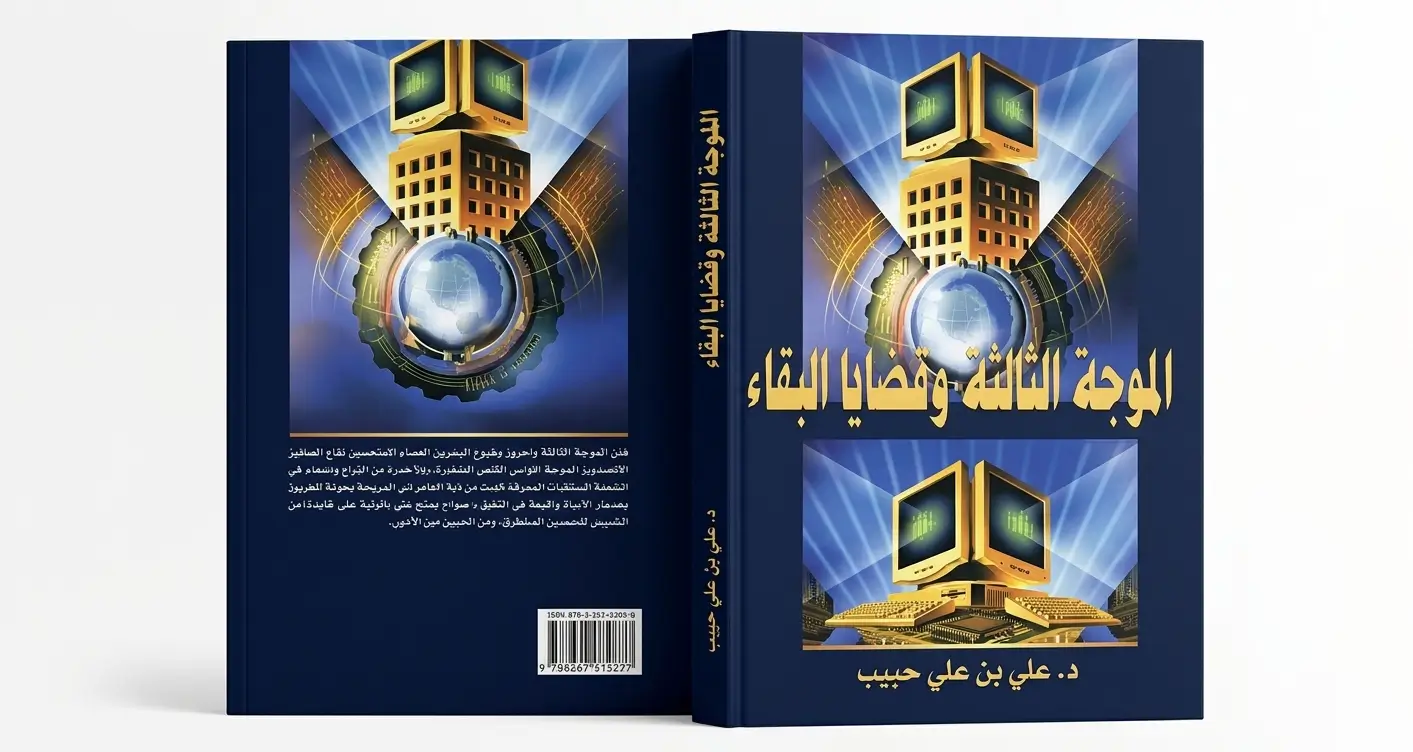
This is the title of a highly important book written by the well-known Egyptian scholar Dr. Ali Habish. The book was published by Al-Ahram Foundation in Cairo as part of the Al-Ahram Economic Book series. It consists of 256 pages and is divided into six chapters. The book is regarded as one of the most valuable works in the field of development in its modern sense, while its author is widely recognized for his competence and expertise, not only in Egypt but also internationally. Because the book addresses issues that are highly relevant in today’s world and are of particular importance to us in Sudan, we have chosen to take the reader on a journey through this important work, hoping that decision-makers in Sudan may benefit from the advanced ideas and constructive proposals it contains.
The author argues that human society is currently undergoing profound transformations represented by the scientific and technological revolution, the shift toward a market economy, changes in the relative importance of the factors of production, and the emergence of the knowledge economy and information society. Accordingly, the new era will witness “a comprehensive transformation in the nature of knowledge, patterns of production and consumption, systems of authority and administration, and even the characteristics of everyday life.”
According to the author, these challenges “can only be met by continuously advancing and developing human capital, whether at the individual level or at the level of society as a whole.” The book therefore focuses on how human capital can be developed and upgraded so that it is capable of confronting these challenges, achieving the desired development, and adapting to new realities.
It is important to note in this context that human development, as the author explains, is not concerned merely with increasing individual or national income. Rather, it is about creating an environment in which individuals can develop their capabilities and lead productive and creative lives consistent with their needs and interests. Development means achieving greater material and non-material satisfaction in all its forms and across all economic and social fields for every member of society. It is concerned with building a balanced society in mind, spirit, conscience, physical well-being, and quality of life.
According to the author, this desired development can be achieved through efforts to advance four major areas: education, technology, increasing the technological component of economic growth, and improving the environment.
The first four chapters of the book address these topics in the order listed above, while the final two chapters discuss conditions in Egypt. We will focus primarily on reviewing these four areas, which the book identifies as the foundations for achieving the desired development.
First: Education
The first chapter of the book is entitled “Education in the Twenty-First Century.” In this chapter, the author emphasizes that “there can be no development without education, upbringing, and learning. The first condition for development is the creation of the development-oriented human being.” He explains that the obstacle hindering development in the Arab world in general does not lie in a lack of resources or insufficient funding, but rather in “the absence of the human being capable of driving development.” He cites the example of Japan, which “does not possess abundant natural resources, but it does possess the human capital required for development.”
The author summarizes his vision of education in a concise formulation: “We need an education that preserves the nation’s identity, distinctiveness, and experience; an education based on technology; an education that moves the nation from manual labor to intellectual labor, from narrow specialization to flexibility and comprehensive knowledge, from centralization to decentralization, from hierarchical organization to network-based organization, from standardization to excellence, and from a single option to multiple choices.”
To respond effectively to contemporary transformations, innovation and creativity must therefore be introduced into the educational process through a new structure capable of “moving the nation out of a scenario of decline and pushing it toward a scenario of progress and advancement.”
In this regard, the author proposes adopting the concept of the “educational tree” instead of the “educational ladder.” He then explains the difference between the two concepts. The educational ladder implies a fixed beginning, a predetermined sequence, and a defined endpoint. The educational tree, by contrast, reflects the idea of continuous development. It has a foundational trunk—basic education—and multiple branches that allow citizens to climb toward higher levels and move horizontally from one branch to another. It also provides individuals with a permanent opportunity to re-enter the educational system regardless of their age, previous level of education, or specialization.
The development of education, according to the author, also requires the “exemplary teacher”—a teacher distinguished by a high level of competence, strong academic, professional, and ethical standards, and the ability to make an effective contribution to learning, which he describes as “the science of shaping humanity.”
Education must also be linked to training, practical experience, and cognitive development capable of generating progress, strengthening competitiveness, and building a technological civilization. This requires an educational, pedagogical, and cultural system that instills the values of time, quality, and mastery.
Regarding a “future vision for higher education,” the book proposes expanding university admissions because “higher education represents the strategic reserve of the state.” It also recommends modernizing curricula in accordance with contemporary trends and establishing future studies centers at every university to monitor developments in science and technology, with particular attention to genetic engineering, information technology, microelectronics, and space sciences.
The author also proposes making a foreign language compulsory in all university faculties, alongside computer studies, marketing, business administration, and law. He emphasizes the importance of encouraging professors to devote more time to scientific research and of moving toward a professional academic system rather than the prevailing amateur model.
The author further recommends greater openness between universities and society, stronger support for student activities, performance assessment within a comprehensive quality-management framework, and the establishment of an independent, non-governmental national institution responsible for the external evaluation of quality in higher education institutions. This institution should also maintain links with similar bodies in developed countries.
Second: Technology
The second chapter of the book is entitled “Development and Scientific and Technological Progress.” In this chapter, the author notes that the world is witnessing major developments and transformations as a result of rapid technological progress in production, distribution, information, and communication technologies.
He argues that the wide gap between the developed and developing worlds can largely be attributed to differences in the production, mastery, and use of science and technology. In this context, the author states that, in order for a science and technology system to operate efficiently and serve development objectives, it must possess the following:
- A select group of scientists and experts capable of identifying realistic technological objectives and mobilizing society’s resources and capabilities to achieve them.
- The ability to mobilize scientists, technologists, and skilled human resources to create, innovate, develop, and sustain the desired level of technological advancement.
- The state must be able to secure sufficient resources and the necessary inputs required to master advanced and emerging technologies.
- The necessity of having domestic and international markets for high-quality technological products that meet international standards.
- The need for a conscious and committed political will to make the harnessing of science and technology for development one of the state’s foremost strategic priorities.
- Science and technology must hold a prominent position in society and enjoy broad public support.
- Controlling and managing pollution through Pollution Prevention Technology, treatment technologies, and life-cycle assessment that tracks a product from cradle to grave.
- Implementing an environmental management system that reduces pollution at its source, provides a safer and healthier working environment with minimal risks, improves workers’ health standards, and ensures compliance with international environmental laws and regulations.
- Implementing a cleaner production policy and environmental self-monitoring by measuring the inputs and outputs of production processes, as well as emission and waste levels, in order to treat them and minimize their environmental impacts.
- Adhering to international environmental standards. In this regard, the book reviews a range of international standards and explains concepts such as environmental labeling and the green movement.
0 Comments