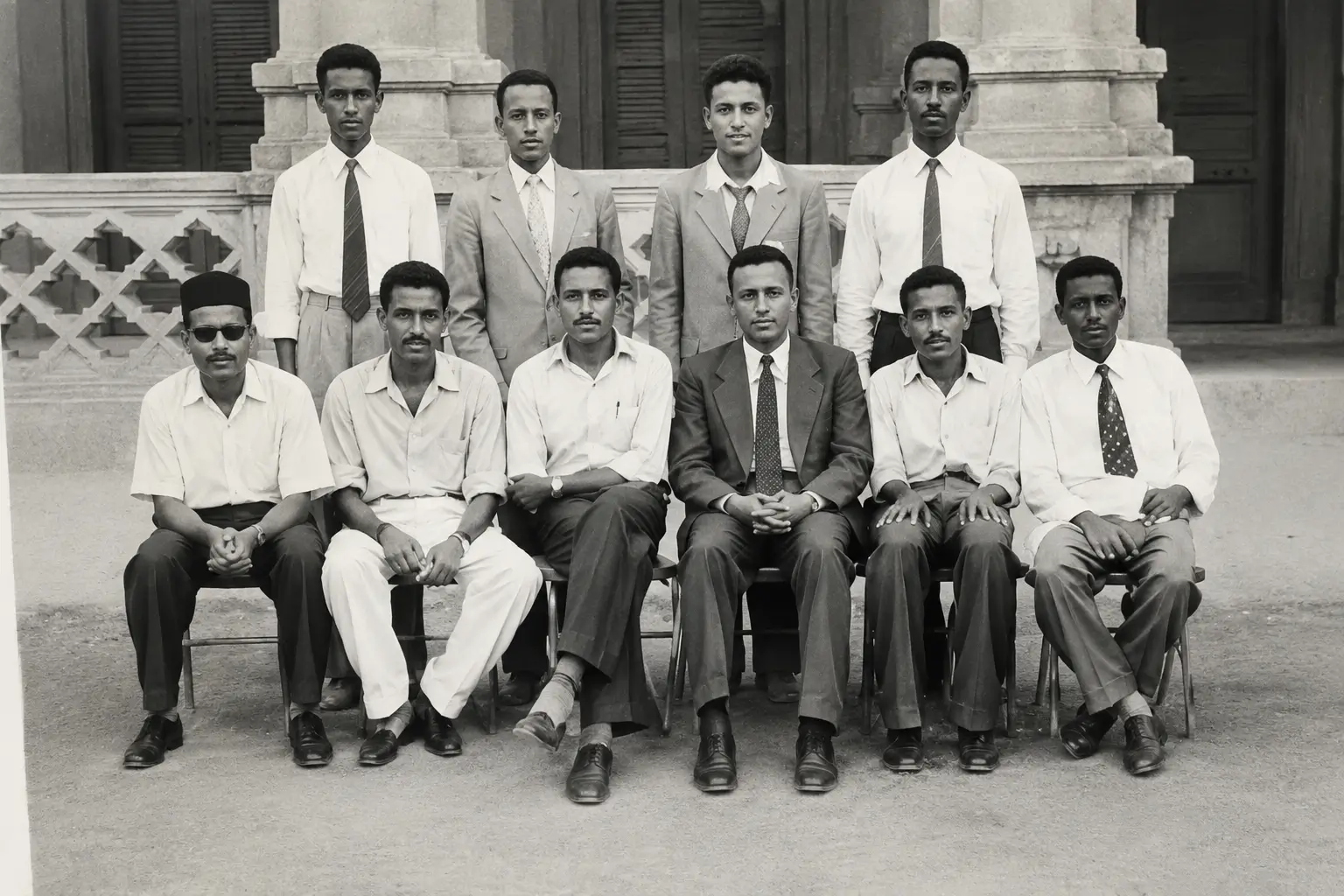
Sudanese student organizations emerged in the late 1930s within the broader national movement opposing colonial rule. From that time onward, students became deeply involved in political activity and led a number of strikes with clearly political objectives. Other organizations also expressed solidarity with the students, as occurred during the 1949 strike by students at Khor Taggat School, which received support from the General Federation of Sudanese Trade Unions. Student efforts continued as part of the national liberation struggle until Sudan achieved independence on January 1, 1956.
Since resistance to colonialism had provided the broad framework under which all political forces in the country—political parties, professional associations, and sectoral organizations—had united, independence removed this common unifying factor. At the same time, it created new political opportunities and economic gains for which different groups competed intensely. This contributed to sharp political conflicts among these organizations in the post-independence period.
These political organizations sought to expand their influence within universities. As a result, almost all major political parties established branches inside Sudanese universities that spoke in their name and defended their positions before students. This pattern has continued from Sudan’s independence to the present day.
Despite this long history, a study supervised by the author of this article found that committed membership in student political organizations remained remarkably limited. The findings indicated that the proportion of Sudanese university students who were politically affiliated and organizationally committed did not exceed 7 percent of the total student population. The study therefore sought to identify the reasons behind this apparent paradox.
Sudanese student organizations first appeared in the 1930s when Sudanese students established the Culture and Reform Society in 1938. This opened the way for the development of organized student activity across Sudan. Student organizations played a pioneering role in confronting the colonial administration and coordinated their efforts with other national forces, including political parties, trade unions, and women’s organizations. After independence, student organizations remained at the heart of political struggles, whether in support of or opposition to ruling regimes.
However, an examination of the Sudanese student experience reveals a strong relationship between student organizations and the country’s political parties, to the extent that some have described student organizations as little more than the university-based arms of political parties. Although these organizations have exercised considerable influence over university life, the proportion of students formally affiliated with them remains relatively small, at slightly more than 7 percent.
The study found that 92.9 percent of respondents were not affiliated with any political party, while only 7.1 percent confirmed that they belonged to political parties. Of these, 4.3 percent belonged to ideological parties, 1.1 percent to historic national parties, 0.5 percent to Arab nationalist parties, and 1.1 percent to ethnic or regional groups. The study therefore sought to understand why students were reluctant to participate politically or join student organizations.
The study relied primarily on a statistical approach using questionnaires distributed among students at four Sudanese universities. Analysis of the collected data produced a number of findings. Among them was a clear reluctance among students to engage in political activity, with 55.5 percent of respondents expressing this view.
The reasons behind students’ withdrawal from political participation included academic pressures and commitments; frustration with the policies and mistakes of successive Sudanese political regimes, which led some students to distance themselves from political activity altogether; the weakness of student political organizations and their inability to represent students’ interests effectively; and the perception that these organizations lack independence and function merely as extensions of political parties operating outside the university environment.
Students also believed that student organizations were more concerned with serving the objectives of the external political parties to which they were affiliated than with addressing the actual concerns of university students.
At the same time, a large proportion of students—more than 65 percent—emphasized the importance of participating in student organizations and promoting democratic culture and a culture of participation among students. They also regarded involvement in student political activity as a distinctive educational experience through which students should pass.
According to these respondents, student organizations should help develop students’ personalities, leadership abilities, and dialogue skills. They can also serve as valuable sources of information and effective means of practical training.
Nevertheless, students stressed that political organizations had failed to gain their loyalty. They argued that student organizations had become instruments used by political parties to conduct their broader political struggles. They also observed that political parties and their student branches tended to become active in providing services to students primarily during election periods in order to gain their support, while neglecting their demands under normal circumstances.
Students further noted that the political discourse of student organizations largely reproduced the discourse of the political parties to which they belonged. The mission of student organizations therefore closely resembled that of political parties outside the university environment, despite the significant differences between the university setting and the broader political arena.
As a result, the discourse of student organizations often failed to satisfy the intellectual, psychological, and social needs of university students. The complete control exercised by political parties over their student branches also negatively affected these organizations. In addition, student organizations were characterized by weaknesses in planning and operational mechanisms. Together, these factors contributed to low levels of student participation in political affairs more generally.
A segment of students also believed that reluctance to engage in political activity was not caused only by the shortcomings of student political organizations. They argued that political activity itself should not be regarded as a central priority of university life, that political involvement can distract students from their studies and academic achievement, and that political activism can draw students into conflicts that divert them from their primary educational mission.
Based on the findings of the study—which cannot all be presented here due to space limitations—the study recommended the following:
- Developing the political discourse of student organizations in a way that responds to students’ intellectual needs while taking into account the distinctive characteristics and specific requirements of the university environment.
- Focusing on addressing students’ concerns and giving greater attention to service-related issues that affect broad segments of the student body.
- Developing a year-round plan for providing services to students, rather than limiting such services to election periods.
- Enhancing the intellectual development of student leaders and encouraging them to read widely and keep abreast of contemporary developments.
- Promoting coordination between student leaders in Khartoum and their counterparts in the states in order to exchange views and experiences.
- Establishing a balanced relationship between student organizations and political organizations outside the university environment, while ensuring that student organizations prioritize students’ interests whenever their positions conflict with those of external political forces.
- Balancing academic commitments with student union and political activities, so that student leaders serve as role models for the rest of the organization’s members and do not neglect one responsibility at the expense of another.
- Providing students with accurate and objective information and avoiding misinformation, exaggeration, and sensationalism.
- Raising political awareness among the organization’s grassroots members and providing them with the necessary information on political issues at the domestic, regional, and international levels.
- Enhancing the effectiveness of political organizations through proper training of their members and mobilizing the membership to achieve the established objectives.
- Conducting regular evaluations and reviews of previous political activities and practices, while clearly and precisely defining future objectives.
- Encouraging a spirit of initiative among students and providing opportunities for the free expression of opinions.
- Maintaining impartiality and objectivity in the selection and advancement of student leaders, with individual merit and personal achievement serving as the primary criteria.
- Building a balanced relationship between student organizations and political parties that allows student organizations to choose the most appropriate methods for their political activities without direct interference from the party.
- Giving greater attention to students’ human development in order to build well-informed, well-trained, and capable cadres who can contribute effectively.
- Organizing an intensive nationwide tour program for student leaders to familiarize them with Sudan’s diverse communities and its social and cultural conditions.
- Avoiding violence as a means of resolving political conflicts within the university environment.
- Encouraging students to join political organizations by promoting a spirit of solidarity and cooperation among students, working to address the problems affecting the student community, setting a positive example, maintaining a balanced political discourse, and avoiding personal attacks against student leaders.
- Developing a student charter for political engagement, to be signed by all student political organizations, committing them to tolerance, dialogue, and the rejection of violence in their relations with one another and with others.
0 Comments