Dr. Bahaa El-Din Makawi
Published in Trending Events magazine, Issue No. 18, July–October 2016.
There is perhaps no term in the political lexicon that has captivated people’s hearts and minds as much as democracy. The term encompasses a set of lofty principles and noble human values, including freedom, equality, justice, transparency, the rule of law, and others. It is therefore unsurprising that the global arena has witnessed uprisings, revolutions, and even wars and bloodshed in the name of democracy. Peoples have continued to demand it and struggle for it, while governments of all kinds have sought to associate themselves with it, whether genuinely and truthfully or falsely and deceptively.
Some authoritarian governments have continued to promise their peoples democracy while manipulating them by imposing partial or limited forms of democracy at times and rigging elections at others. Yet despite repeated attempts to undermine it, democracy continued to spread. While the world had virtually no genuinely democratic states at the beginning of the twentieth century, the number of democratic countries had risen to around 120 by the mid-1990s.
In Latin America, several countries transitioned toward democracy, including Brazil, Chile, Mexico, Argentina, and others. Similar transformations occurred in a number of Asian countries such as Indonesia, South Korea, and Pakistan. In Africa, the 1990s witnessed broad democratic transitions that brought an end to the one-party systems that had prevailed in many countries. This period came to be known as Africa’s “second liberation,” with the first liberation referring to independence from colonial rule. Likewise, at the beginning of 2011, Arab peoples overthrew authoritarian regimes in a number of countries, including Tunisia, Egypt, Libya, and Yemen.
At the same time, however, the world also witnessed the rise of non-democratic regimes through military coups. Some countries failed to complete their democratic transitions, which plunged them into bloody civil wars, as occurred in Syria, Yemen, and Libya. Long-established democracies, during their war on terrorism, also became involved in practices that contradicted some of the most basic principles of democracy and conflicted with public and religious freedoms.
More recently, increasing attention has been given to the relationship between security and liberty and to the question of whether societies are inevitably required to choose between the two. The details of this issue will be discussed through three main themes, as follows:
First: Manifestations of the Decline of Liberal Democracy:
The most prominent manifestation of democratic decline has been the return of military coups after their relative disappearance for nearly two decades following the end of the Cold War. This decline was also linked to the policy of political conditionality adopted by Western countries toward developing states, whereby aid and grants were tied to progress in political reform. Nevertheless, the period between 2006 and 2012 witnessed military coups in a number of countries, including Bangladesh, Mauritania, Thailand, Fiji, Madagascar, Honduras, Mali, Niger, and Guinea-Bissau, among others. In other countries, the military did not stage a direct coup against the existing government but nevertheless regained a central role in political life, as occurred in Mexico, Ecuador, Pakistan, and the Philippines.
Public confidence in democracy as an ideal form of government also declined in some countries, such as Venezuela, the Philippines, and Bolivia, where segments of the population took to the streets demanding the removal of elected governments and expressing a sense of “nostalgia for the past.” This reflected deep frustration with newly elected leaders who had failed to meet popular demands.
Opinion polls conducted by the Global Barometer also indicated declining levels of support for democracy in sub-Saharan Africa and in several Latin American countries, including Colombia, Ecuador, Guatemala, and Peru.
Public frustration also grew toward the policies and conduct of some elected leaders, as seen in countries such as Russia, the Philippines, and Hungary. The 2014 Freedom House Report stated that the approach adopted by some elected rulers amounted to a form of “modernized authoritarianism,” in which they sought to restrict the activities of their opponents without eliminating them entirely, while manipulating laws in ways designed to preserve their political legitimacy.
Elected governments in long-established democracies with deeply rooted liberal traditions were also accused of violating democratic principles and human rights. The United States was frequently cited in this regard because of practices at Guantanamo Bay, Abu Ghraib, and elsewhere following the September 11 attacks. Switzerland, for example, held a referendum in late 2009 on banning the construction of minarets. The ban was approved by 57.5 percent of voters, prompting widespread criticism from human rights organizations, which argued that the measure was unnecessary, risked fueling hatred, represented a retreat from basic rights and religious freedoms, and was inconsistent with the democratic traditions of a country such as Switzerland.
Following the terrorist attacks in Paris, French President François Hollande announced an extension of the state of emergency. His government adopted measures that included proposals to revoke the citizenship of certain dual nationals suspected of involvement in terrorism, broadened the concept of self-defense for police officers, and imposed severe restrictions on civil liberties. In some cases, these restrictions extended to placing political activists under house arrest. The International Federation for Human Rights described such measures as serious infringements on individual freedoms and a grave violation of the rule of law in France.
According to international reports, global freedom declined for the eighth consecutive year, democracy deteriorated in 48 countries worldwide, and 27 democratic states regressed toward authoritarianism. The Arab Spring, meanwhile, ended in civil wars, conflicts, and disorder in several countries and failed to achieve many of its intended objectives.
Second: Causes of the Decline of Liberal Democracy:
The causes of the decline of democracy worldwide can be summarized as follows:
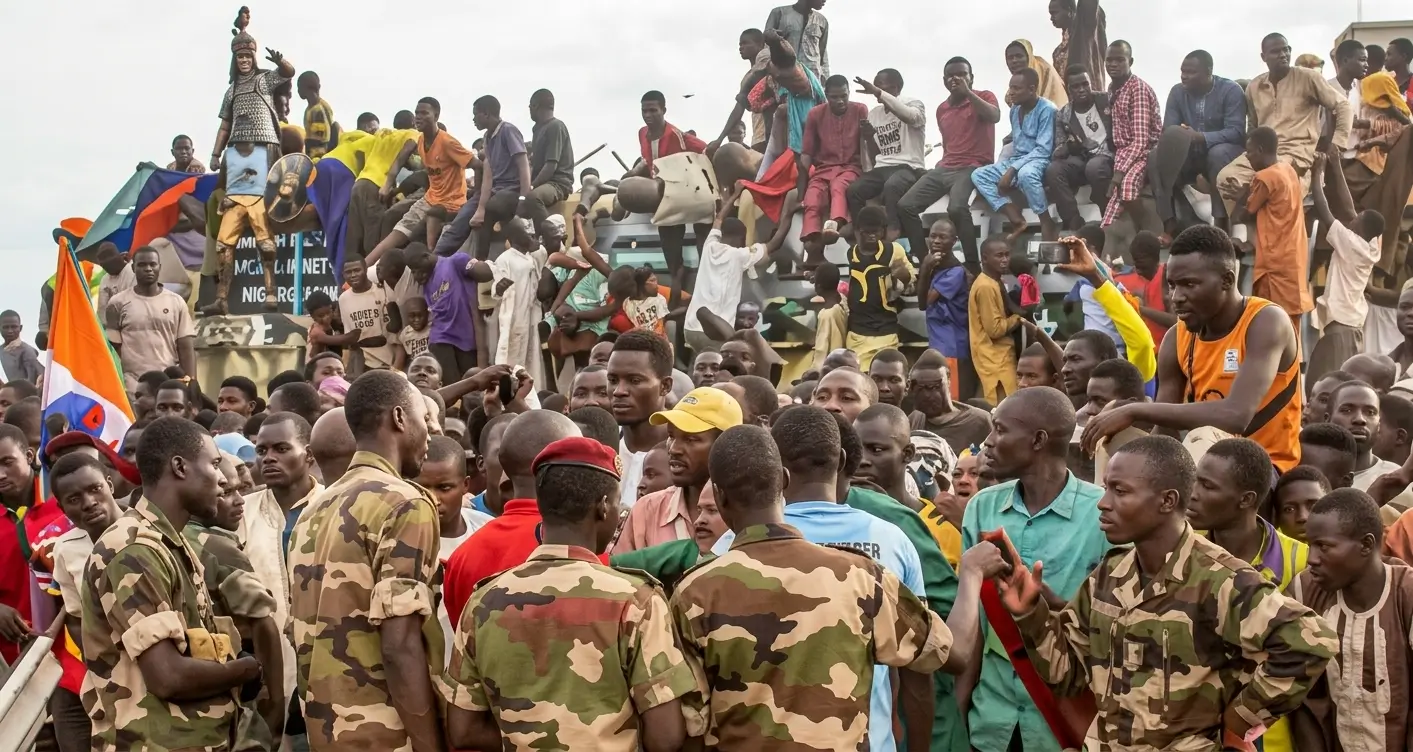
- The political ambitions of some military leaders, combined with weak political culture in many countries, have led to military coups that brought democratic political systems to an end and resulted in a return to authoritarian rule.
- The failure of new leaders in countries undergoing democratic transitions to restructure the political system in a way that supports both the transition itself and the long-term sustainability of democracy has also contributed to democratic decline. For example, political institutions in Egypt remained largely unchanged after the revolution, which weakened the democratic system. By contrast, the dismantling and restructuring of former institutions on new foundations during the democratic transitions in Spain and Portugal helped ensure the continuity and consolidation of democracy in those countries.
- Expectations of rapid results in countries undergoing democratic transitions—where new leaders inherited deteriorating economic conditions—contributed to their failure to meet popular demands, which were largely economic in nature. This was especially significant because many of these transitions coincided with the global financial crisis. As a result, the new leaderships lost legitimacy in the eyes of their populations, and this negatively affected public perceptions of democratic systems more broadly.
- The weakness of political parties and civil society in most transitioning countries—due to the repression and restrictions they endured under authoritarian rule—left them unable to participate effectively during the transition or contribute meaningfully to the consolidation of democracy. As a result, the new political forces that came to power lacked strong support in their confrontation with remnants of the former regimes and in their efforts to institutionalize democratic practices and institutions in their countries.
- The failure of democratic transition processes in some countries, as occurred in Libya, Yemen, and Syria, and their descent into civil wars led to a decline in reform efforts, as fears grew over the potential consequences of pursuing similar attempts at political change.
- The tendency to frame security and freedom as opposing values, and to portray democracy as being incompatible with security, has also contributed to the decline of liberal democracy. This was evident following the Bardo National Museum attack in Tunisia in March 2015 and the Paris attacks in November of the same year. However, this assumption is not necessarily valid, as many European countries have remained stable and secure while maintaining democratic systems and protecting individual freedoms. The issue of terrorism should therefore be separated from the question of liberty, and greater attention should be given to examining the underlying causes of terrorism and the most effective ways of confronting it, rather than engaging in an unproductive debate that presents security and freedom as mutually exclusive. As Benjamin Franklin famously stated, “Those who would give up essential Liberty, to purchase a little temporary Safety, deserve neither Liberty nor Safety.”
- The complicity of some Western governments in supporting military coups and restricting emerging democratic forces, as indicated by several credible sources.
0 Comments