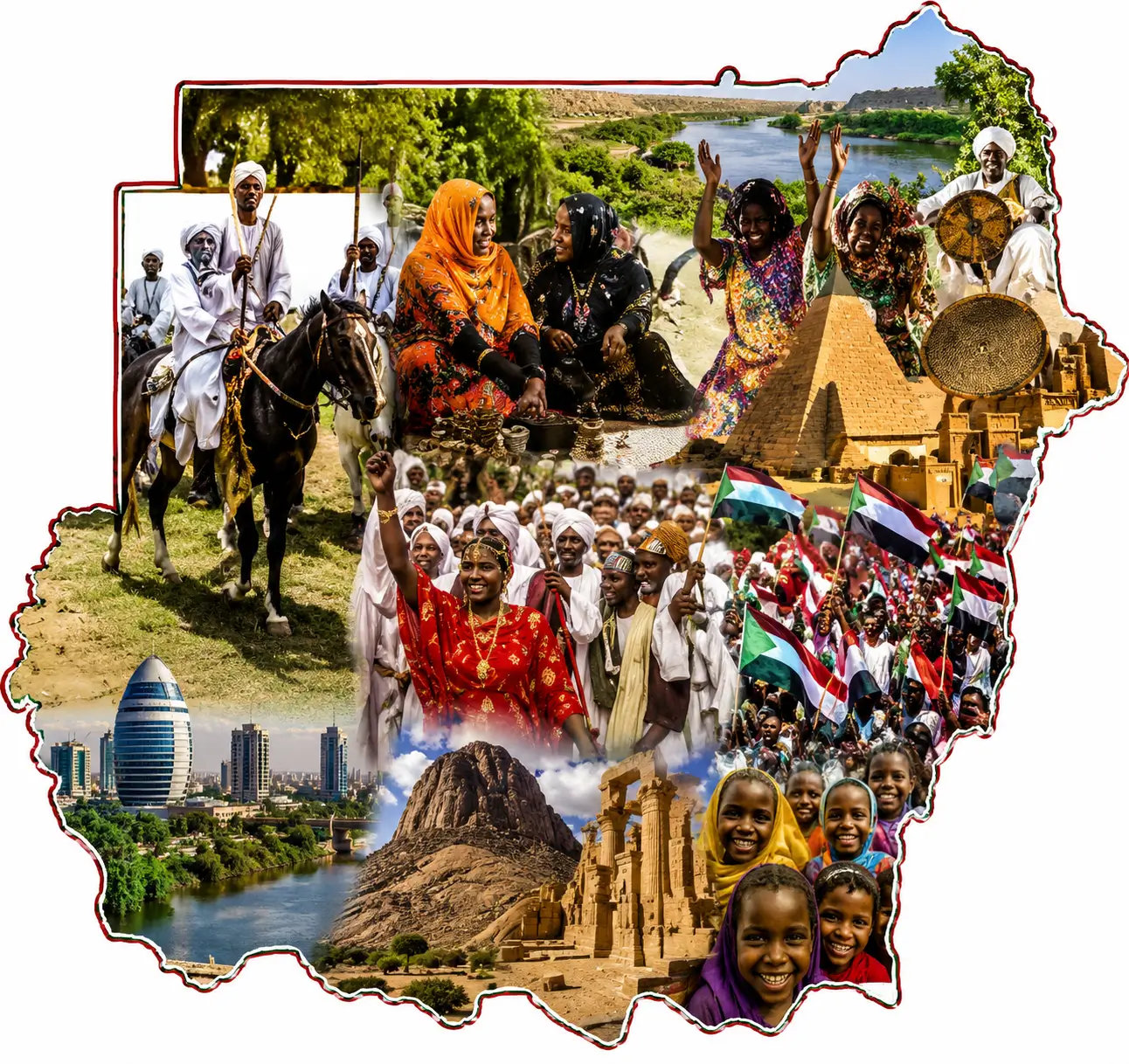
Achieving national unity is a top priority for all states without exception. Unless such unity is realized, the state remains incapable of achieving any other objective, whether economic, social, or political. For this reason, states generally place national unity at the forefront of their priorities because of its central importance and strategic significance.
It should be noted, however, that national unity faces numerous risks and serious challenges in most African countries for well-known historical reasons. In Sudan in particular, national unity faces major challenges, especially following the secession of South Sudan.
The serious and far-reaching challenges confronting national unity in Sudan, and the difficult test to which it is being subjected, require a serious approach to this vital and existential issue, along with the development of a strategic perspective for achieving and consolidating national unity.
By national unity, we mean in this article a state of convergence and harmony among the members of the national community—the population of the state as a whole—which prevents division and conflict and, at the same time, promotes cooperation and participation in nation-building and in achieving the shared interests of society.
National unity in Sudan faces a number of challenges that can be summarized as follows:
1. The Relative Modernity of the Sudanese State
The Sudanese state in its present form is not yet two centuries old, a period that is insufficient by any measure for achieving full national integration and cohesion among the different groups of the Sudanese population.
If we take into account, on the one hand, the historical weakness of transportation and communications and, on the other, colonial policies that sought to prevent national integration in Sudan, we can understand the wide gap between the present Sudanese reality in terms of national unity and the ideal level of unity to which the country aspires.
Despite the efforts made by Sudanese nationalists to achieve national integration, the absence of a clear vision for building the Sudanese state caused these efforts to falter and prevented them from reaching their intended objective. Nevertheless, relatively few studies have focused on the importance of this historical reality—the relative modernity of the Sudanese national experience. Most studies and media discussions instead emphasize the supposed impossibility of coexistence among certain Sudanese groups.
The relative modernity of the Sudanese state requires the government to deal with the country’s circumstances in an exceptional manner that recognizes this reality. This should promote national cohesion through educational curricula, the media, development policies, and fairness in the distribution of political authority and public positions, so that tensions do not erupt in a country that is still undergoing a process of national formation.
Claims that coexistence among some Sudanese groups has failed are not supported by sufficient evidence, because these groups have not yet been given adequate opportunities for social integration and cultural interaction capable of producing strong and lasting national unity.
2. The Dominance of Sub-National Loyalties
Sub-national loyalties generally refer to attachments to the tribe from which an individual originates, the region in which he or she was born, the language spoken, or the values and traditions with which the person identifies, without these loyalties being transcended by a stronger allegiance to the state.
An examination of Sudanese society shows that individuals are often classified first on an ethnic basis, followed by other cultural classifications such as language, religion, and customs.
Although some argue that sub-national loyalties tend to decline as education expands, the Sudanese experience suggests otherwise. Despite the significant expansion of education over the past two decades, tribalism and regionalism have increased noticeably.
In some cases, tribes and regional groups have even taken up arms against the Sudanese state, demanding development for their regions and greater participation by members of their communities in political power. Some openly advocate the distribution of power and wealth on tribal, regional, and geographic bases.
Sub-national loyalties therefore represent one of the greatest challenges to national unity in Sudan. Unless appropriate mechanisms are developed to address this phenomenon, national unity will remain under constant threat.
3. Unbalanced Development
Economic grievance was one of the most important factors driving the conflict in southern Sudan. After the secession of the South, the peripheral regions of the remaining Sudan, without exception, including what has sometimes been described as the “new south” of Sudan, continue to suffer from poverty, deprivation, and hardship.
The objective of colonial rule in Sudan, as in many other African countries, was not to achieve balanced development. On the contrary, developmental disparities served the British colonial strategy of “divide and rule.”
Development projects established in some parts of the country generated resentment among communities deprived of similar opportunities, contributing over time to deep fractures in national unity.
After independence, it was expected that development strategies would be reconsidered. Indeed, the issue was debated, and two main approaches emerged.
The first called for distributing future development projects across all regions of the country in order to achieve balanced development. The second argued that the central regions possessed economic advantages because they already had services and infrastructure that reduced production costs. According to this view, development projects should remain concentrated in the center, while the revenues generated should be distributed among the different regions of Sudan.
In practice, neither approach was implemented effectively. Development projects were not sufficiently expanded into the different regions, nor were the benefits of development adequately redistributed to the peripheries.
Instead, development continued to be concentrated in the center, while peripheral regions remained underdeveloped. This contributed to a growing sense of developmental grievance and to the widespread use of the language of marginalization and neglect.
Addressing this clear developmental imbalance and placing balanced development at the core of national planning is therefore one of the most appropriate approaches to strengthening national unity and reducing the risks of fragmentation and division. It is also the most effective response to claims of marginalization in Sudan’s peripheral regions.
4. The Absence of a Clear Vision for Managing Ethnic and Cultural Diversity
It has become clear that Sudan needs a new and coherent strategy for managing diversity. Despite the secession of South Sudan, the country still contains hundreds of ethnic and social groups, dozens of languages and dialects, religious pluralism, and major economic and developmental disparities.
The policy of assimilation or containment pursued by successive Sudanese governments since independence has failed. This has highlighted the importance of moving toward the concept of functional integration—a model of governance not based on the existence of a single shared identity, but rather on common interests.
Under such an approach, different groups would be brought together within a broad state framework while being enabled to pursue their interests and express their distinctive cultural identities.
At the same time, because national unity has suffered deep fractures, Sudan needs new foundations for unity that move beyond emotional loyalty and are instead based on shared interests.
This means that the political center in Sudan should become a source of attraction for the regions, peripheral areas, and different communities, with shared interests forming the basis of that attraction. Different groups should see value in remaining within a political center that provides them with access to authority, wealth, opportunity, influence, and national prestige.
The challenge is how to make the center sufficiently attractive to accommodate the interests of different groups in a manner that strengthens national unity. This requires serious intellectual and policy engagement by Sudanese politicians and experts.
5. Following the Example of South Sudan
After conflict with the central government that lasted for approximately half a century—interrupted by only eleven years of relative peace between 1972 and 1983—the Comprehensive Peace Agreement was signed in early 2005 and eventually led to the secession of South Sudan.
Immediately after the secession of the South, voices emerged in other parts of Sudan calling for the same “right to self-determination.”
Unless appropriate policies and measures are adopted, this trend could lead to the further fragmentation of Sudan into weak and marginal states.
The tendency of other regions to follow the example of South Sudan therefore represents one of the greatest challenges facing national unity in the country.
6. Foreign Interference in Sudanese Affairs
Anyone closely following Sudanese affairs can observe extensive interference by both neighboring and distant states, each seeking to advance its own national interests.
Confronting foreign interference requires sound domestic policies and a carefully designed national strategy aimed at reducing the spread of protest movements and internal grievances that create opportunities for external powers to intervene.
Efforts to limit foreign interference in Sudanese affairs are therefore among the most important challenges facing the achievement and consolidation of national unity.
In conclusion, this article has attempted to identify the principal challenges facing national unity in Sudan. In the next article, God willing, we will present a number of proposals that may contribute to outlining the basic features of a strategic perspective for strengthening and consolidating national unity in Sudan.
0 Comments