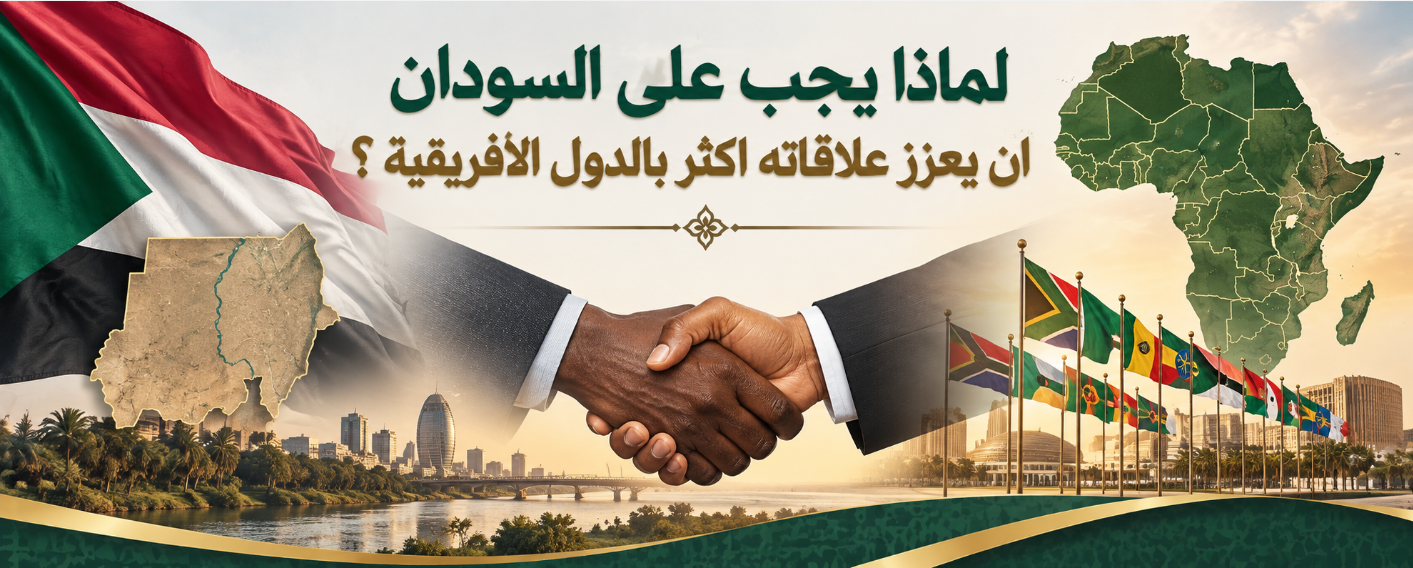
Sudan has long maintained strong and well-established relations with African countries, and this has been the case since independence. Sudan has invested politically, economically, and culturally in the African continent, despite the fact that Africa has often appeared in international news primarily in connection with poverty, underdevelopment, and famine. These efforts have helped strengthen Sudan’s standing in Africa in a remarkable way, as reflected in many African positions supportive of Sudan and sympathetic to its causes.
Although successive Sudanese governments have generally sought to build bridges of friendship and solidarity with African countries, this article aims to draw attention to the importance of continuing and deepening this approach. This is particularly important because new realities have emerged in recent years concerning Africa and its promising future, while observers have also noted the growing competition among major powers seeking to strengthen their relations with the continent and gain access to its large and increasingly attractive markets.
This therefore represents an opportunity for Sudan, which has long extended assistance to its African neighbors and partners, to prepare for a new phase in its relations with African states. Sudan can contribute the accumulated experience, expertise, and resources it possesses at a time when many African countries are entering new stages of growth, while at the same time strengthening its own presence on the continent and benefiting from the significant opportunities that are beginning to emerge.
One of the most important reasons Sudan should give Africa greater priority in the coming period is that Africa is increasingly regarded as the continent of the economic future. Indeed, the twenty-first century may well become Africa’s century. The continent remains rich in largely untapped reserves of energy, minerals, agricultural resources, and livestock wealth, to the extent that it has sometimes been described as the “reservoir of the world.”
This abundance of resources helps explain the growing international attention Africa is receiving and the increasingly intense competition among major global powers seeking economic partnerships with African countries in order to benefit from their enormous resources.
The annual African Economic Outlook report issued by the African Development Bank has stated that Africa’s agricultural, energy, and mineral resources—many of which remain largely untapped—are key to accelerating the continent’s economic growth.
According to the report, Africa possesses around one-third of the world’s mineral reserves, including approximately 40 percent of global gold reserves, around 90 percent of platinum and chromium reserves, one-fifth of the world’s diamonds, approximately 30 percent of uranium reserves, and around 6.6 percent of natural gas reserves.
In the energy sector, Africa holds approximately 12 percent of the world’s oil reserves. In agriculture, around 60 percent of the continent’s land is considered suitable for cultivation, much of it still unused. According to the African Development Bank, only a very small proportion of Africa’s potentially cultivable land is currently being farmed.
For much of its modern history, Africa functioned primarily as a supplier of raw materials and cheap labor and as a market for manufactured goods. Today, however, it has increasingly become a destination for international investment.
Foreign direct investment in Africa rose from approximately $15 billion in 2002 to $37 billion in 2006, then to $46 billion in 2012, reaching around $57 billion in 2013. Economists have argued that the continent could become one of the regions making the greatest contributions to global economic growth, with the combined GDP of Sub-Saharan African countries expected to increase substantially in the coming decades.
According to Sky News, Africa has recorded average annual growth of around 6 percent and has become an arena of competition among the world’s largest economies. Chinese investments in Africa have exceeded tens of billions of dollars, while United States investments have also reached very high levels.
Trade between China and Africa has grown significantly, surpassing trade volumes between Africa and the United States according to statistics from the period under discussion.
The world’s perception of Africa has changed dramatically. In 2001, The Economist placed the phrase “The Hopeless Continent” on its cover in reference to Africa. Barely a decade later, in 2011, the same magazine published a cover describing “Africa Rising.”
Some media outlets have also begun referring to “African economic tigers,” a term used for countries that have achieved notable rates of GDP growth.
Rwanda, for example, recorded average annual GDP growth of around 8 percent between 2001 and 2014. Côte d’Ivoire achieved economic growth of approximately 8.4 percent in 2015 and 8.5 percent in 2016, while Kenya was expected at that time to increase its growth rate from approximately 5.9 percent in 2016 to around 6.1 percent in 2017.
The G20, which brings together the world’s leading industrial and economic powers, also identified partnership with Africa as an important priority. This included support for initiatives such as the Compact with Africa, promoted under German leadership.
At the beginning of 2017, Germany’s Federal Ministry for Economic Cooperation and Development also presented proposals for a “Marshall Plan with Africa.” The initiative aimed to support job creation, combat poverty, strengthen peace, and create new opportunities for German companies over the medium and long term, particularly through infrastructure projects involving roads, railways, airports, ports, power stations, and other major investments.
Some Arab and African countries have already recognized Africa’s growing importance and its promising future and have begun planning more seriously for entry into African markets.
In Tunisia, economists called for stronger positioning of Tunisian companies in African markets. They argued that part of the solution to Tunisia’s economic problems lay in gaining access to those markets, particularly in strategic sectors such as industry, telecommunications, energy, healthcare, and tourism. They also called for direct transportation links, a stronger presence for Tunisian banks, and easier financial transactions.
In Algeria, the African Investment and Business Forum was held in December 2016 and attended by around two thousand business leaders and company executives representing approximately forty African countries, in addition to observers and participants from outside the continent. The forum concluded with the signing of more than one hundred contracts and cooperation protocols between Algerian and African businesspeople and economic institutions.
Another factor encouraging Sudan to turn more strongly toward Africa is the considerable political support that African countries have extended to Sudan.
Sudan has faced significant pressure from international and regional powers, yet many African countries have adopted positive and supportive positions toward it.
For example, the African Union strongly opposed United States sanctions on Sudan and adopted decisions calling on member states not to comply with certain measures, while also establishing mechanisms to follow up efforts aimed at lifting the sanctions.
At a time when the Arab League adopted what was viewed as a weak position regarding the International Criminal Court, Ethiopia in 2013 called for an extraordinary African Union summit to discuss the possibility of a collective African withdrawal from the Court in solidarity with Sudan.
South Africa also informed the United Nations Secretary-General of its intention at one point to withdraw from the International Criminal Court, followed by Burundi, amid criticism that the Court had disproportionately focused its investigations on African countries.
African support for Sudan has also been reflected in other disputes, including the fact that maps recognized within African Union frameworks have been cited as supporting Sudanese claims concerning Halaib and Shalateen.
Sudan’s Political Investment in Africa
Africa has never been absent from the thinking of Sudanese political leadership throughout the country’s modern political history.
Khartoum has played an important political, economic, and military role in various African countries. Sudan provided assistance to Somalia throughout the 1990s after the collapse of the Somali state, and it also supported national liberation movements in Somalia, Eritrea, and Ethiopia.
Sudan remained present in many situations where neighboring African countries required assistance. It also provided financial and educational support through Sudanese Islamic institutions and organizations headquartered in the country, including charitable and educational organizations and the International University of Africa in Khartoum.
At the same time, we believe that Sudan’s efforts in Africa are likely to generate greater returns than comparable efforts in many other parts of the world. This makes it necessary to intensify and expand Sudan’s engagement with the continent.
Sudan should therefore strengthen its relations with African countries, giving particular priority to its immediate geographical neighbors. It should increase and activate reciprocal visits between Sudanese officials and their counterparts in friendly African countries, expand investment and economic cooperation, strengthen relations with governing political parties and African parliaments, establish stronger people-to-people relations with African civil society organizations, and work to enhance Sudan’s role within the continent’s various regional and pan-African institutions.
0 Comments